 Keji Mustapha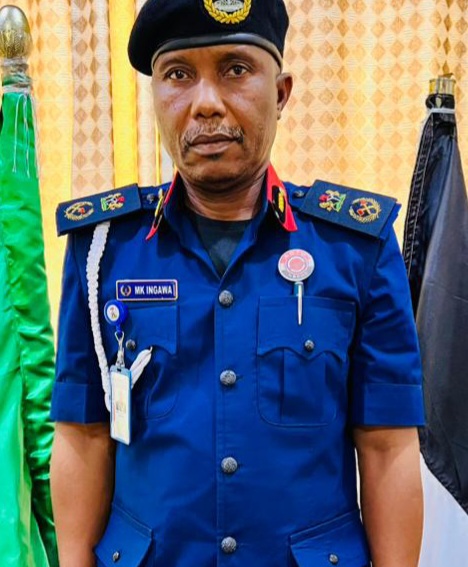
Pix: Commandant Muhammad Kabiru Ingawa
By Isiaka Mustapha, Editor-In-Chief, People’s Security Monitor
When Muhammad Kabiru Ingawa assumed office as the 16th Commandant of the Nigeria Security and Civil Defence Corps (NSCDC) in Jigawa State in late September 2025, it was far more than a routine posting. It marked the beginning of a calculated security renaissance, a carefully designed roadmap anchored on discipline, intelligence, and a deep sense of duty.
Commandant Ingawa arrived in Jigawa with a distinguished record of excellence. In his previous posting as NSCDC Commandant in Nasarawa State, he earned national recognition for operational efficiency, integrity, and strong community engagement. His leadership transformed the Nasarawa Command into a model of effective security coordination, where cases of vandalism, illegal mining, and communal conflict were drastically reduced. Between January and August 2025 alone, his command secured over sixty convictions for crimes linked to critical infrastructure vandalism and economic sabotage. He also pioneered the Safe Market Initiative, a community safety project that trained traders and youth volunteers in fire prevention and emergency response across ten local government areas, an initiative now being considered for national adoption.
The project’s essence was simple yet powerful empowering the people who operate daily in the most vulnerable spaces to become the first responders in emergencies. Commandant Ingawa understood that markets are not only economic hubs but also potential flashpoints for disasters. Through the Safe Market Initiative, traders, artisans, transporters, and youth leaders were trained in fire prevention, crowd control, basic first aid, and emergency evacuation procedure.
At the NSCDC Headquarters, Ingawa’s leadership style was described as ”firm but people-oriented.” His ability to combine intelligence-driven security with empathy and public trust earned him widespread respect. His redeployment to Jigawa was therefore no accident; it was a strategic posting meant to replicate his successes in a state characterized by vast border communities and emerging security challenges.
Upon arrival in Dutse, Commandant Ingawa unveiled a six-point roadmap designed to redefine Jigawa’s security architecture. His priorities include strengthening collaboration with sister security agencies, expanding community-based conflict resolution in partnership with the Public Complaints Commission (PCC), intensifying protection of critical national infrastructure, improving personnel welfare and capacity, promoting grassroots intelligence gathering, and enforcing laws against illegal mining and other forms of economic sabotage.
Since assuming office, he has held a series of consultative meetings with traditional rulers, local government chairmen, and security heads across the state. His message has consistent revolved around security, which he believes must be firmly rooted. Ingawa’s style is proactive rather than reactive; he emphasizes prevention through intelligence, vigilance, and trust-building within communities.
Observers say his vision goes beyond routine security enforcement. It seeks to create a resilient society where the people themselves become the first line of defense. Already, his leadership has begun to inspire renewed confidence in the NSCDC as a dependable partner in the collective pursuit of peace and stability in Jigawa State.
Commandant Ingawa’s roadmap reflects not only his professionalism but also his deep belief that sustainable security is built on inclusion, accountability, and constant dialogue. His steady rise within the Corps and his results-driven management style continue to position him as one of the most promising security administrators of his generation, a man whose mission is to make Jigawa safer, stronger, and more secure for all.