 Keji Mustapha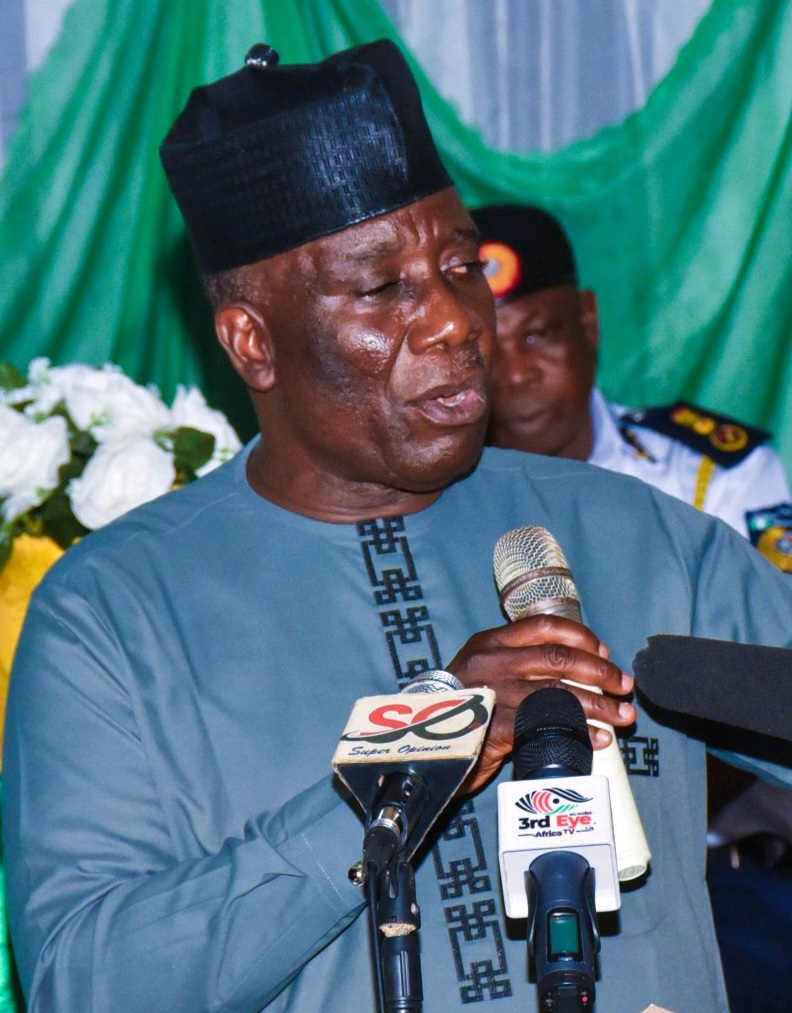
Pix: Retired AIG Wilson Inalegwu
Retired Assistant Inspector General of Police Wilson Inalegwu has called for a complete redesign of Nigeria’s security architecture by strengthening Local Government Security Committees and empowering traditional rulers as frontline partners in tackling insecurity. He made this call while delivering a keynote address at the 2025 Annual Peoples Security Monitor Security Summit and Recognition Awards held on Wednesday 10 December 2025 at the Nigerian National Merit Award House Maitama Abuja.
Addressing security stakeholders, policymakers and community leaders, Inalegwu said Nigeria stood at a historic crossroads in its search for peace and stability. He stressed that the nation cannot overcome its security challenges unless it begins to build security from the ground up, anchoring protection efforts on communities, local governments and traditional institutions.
The retired police chief noted that insecurity often begins at the grassroots before escalating into national crises. According to him, “Banditry, kidnapping, communal clashes and farmer herder tensions take root first in villages, wards and market squares where citizens live and work.” He added that more than seventy percent of incidents recorded between 2021 and 2024 occurred at the community level.
Inalegwu lamented that local governments, despite being constitutionally the closest tier to the people, remain underutilised in Nigeria’s security structure. He argued that the success of community policing, early warning systems and intelligence sharing depends heavily on functional Local Government Security Committees. “If Nigeria must defeat insecurity, we must place local security systems at the very heart of our national strategy,” he stated.
Citing evidence from various states, the former AIG highlighted successful examples where grassroots collaboration reduced crime. He referenced Borno State, where community security networks contributed to a forty percent decline in Boko Haram attacks, as well as Lagos, Katsina and Niger States where local reporting helped track criminal movement before attacks. These cases, he said, prove that Nigeria already has a workable foundation and what is needed now is consistency, scaling and political will.
Inalegwu also emphasized the indispensable role of traditional rulers, describing them as custodians of legitimacy, trust and cultural intelligence. He said traditional institutions possess deep knowledge of local histories, migration patterns and community grievances, making them vital partners in detecting early signs of insecurity. “No external agency understands community dynamics better than traditional rulers,” he noted.
According to him, cooperation between Local Government Security Committees and traditional leaders creates a powerful alliance capable of disrupting criminal networks that exploit weak intelligence coordination. This partnership, he said, strengthens trust, provides real time information to security agencies and prevents violence before it occurs.
The retired AIG warned that failure to prioritize prevention over response has cost Nigeria billions of dollars and displaced millions. He revealed that between 2018 and 2023, insecurity related disruptions cost the country an estimated 10.3 billion dollars, while rural banditry displaced more than 2.6 million people. “Responding to insecurity is far costlier than preventing it,” he cautioned.
Inalegwu advocated technological support for grassroots security, including digital alert platforms, drone surveillance and geo mapped early warning systems. He said Nigeria could adapt lessons from Kenya and South Africa, where community policing frameworks have reduced neighbourhood crime and strengthened public safety.
He further stressed the need to integrate women and youth into community security structures. Women, he said, possess some of the most accurate social intelligence, while Nigeria’s youth population more than sixty percent of the country must be prevented from being exploited by criminal groups through targeted empowerment and engagement programmes.
Inalegwu also called for improved coordination between the Office of the National Security Adviser, state governments and councils across the country to ensure clear mandates and efficient implementation of national security strategies at the grassroots. He maintained that Local Government Security Committees should function as critical subcommittees of State Security Councils, with membership drawn from security agencies, civil society, traditional rulers, women and youth groups.
Closing his address, the retired AIG declared that Nigeria’s future security depends on strengthening local systems and uniting communities with government in a shared mission. “If we strengthen the grassroots, we strengthen the nation. If we empower communities, we weaken criminals,” he said. “This is the pathway to a safer, stronger and more secure Nigeria for all.”