 Keji Mustapha
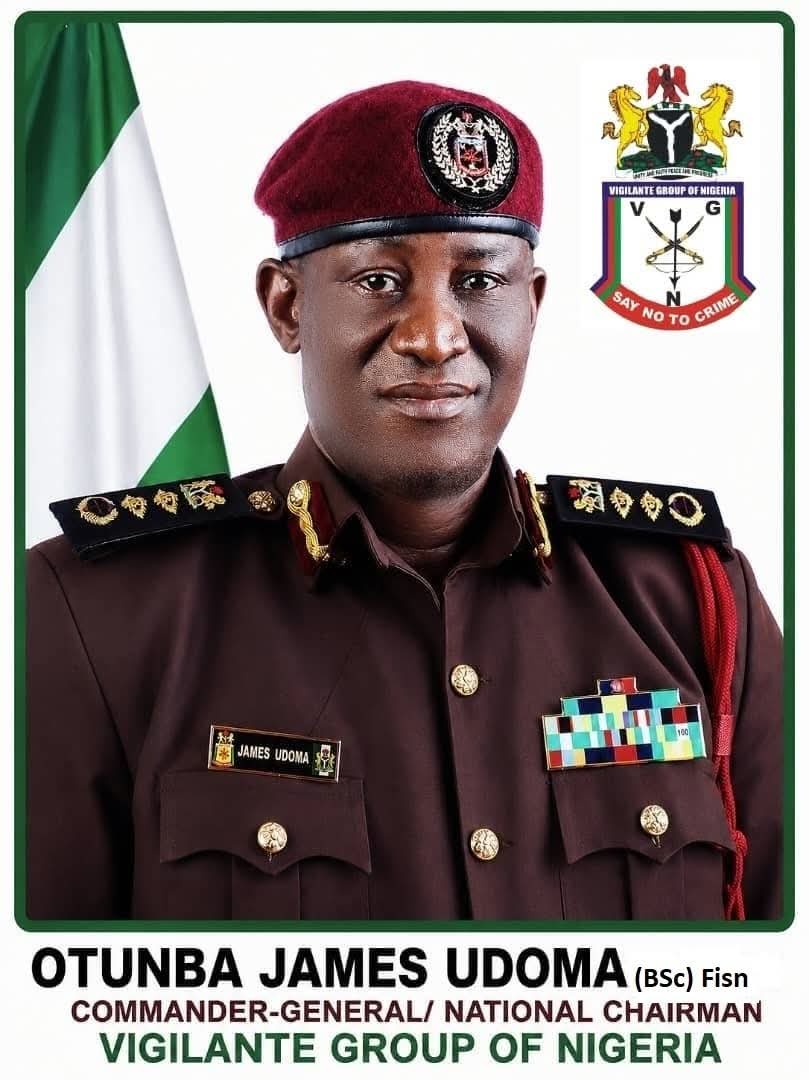
Otunba James Udoma’s VGN Leadership: A Strong Start, A Clear Direction
By Isiaka Mustapha, Editor-in-Chief, People’s Security Monitor
In less than a month at the helm of the Vigilante Group of Nigeria, Otunba James Udoma has moved quickly to define the organisation’s institutional direction, strengthen engagement with government and security agencies, address internal cohesion, and place grassroots intelligence at the centre of VGN’s role in national security. The record so far is more about structures, partnerships and strategic commitments than claims of overnight transformation.
Otunba James Udoma assumed office as Commander-General and National Chairman of the Vigilante Group of Nigeria (VGN) in August 2026, following the death of his predecessor, retired Navy Captain Umar A.B. Bakori. Before his elevation, Udoma served as Deputy National Chairman and Deputy Commander-General. VGN says his emergence was endorsed by its Board, National Executive Council and commanders from the 36 states and the Federal Capital Territory, placing his new administration on an established organisational footing.
The timing is significant. Udoma inherited an organisation operating in a difficult security environment, with vigilante personnel participating in frontline and community-level security operations against kidnapping, banditry and other criminal activities. In his first major media engagement as Commander-General, he identified one immediate operational problem: inadequate equipment. He said VGN personnel had received training in collaboration with the Nigeria Police Force and had been profiled before deployment, but that many were still operating without adequate kits and equipment.
His response has therefore been to put personnel protection and operational capacity high on the agenda. Rather than presenting equipment as an internal matter alone, Udoma has publicly asked the Federal Government to provide the tools required by personnel deployed to dangerous assignments. He also acknowledged that several governors in northern states had already begun equipping VGN personnel in their jurisdictions. The emphasis is measurable: properly trained and profiled personnel must also have the equipment necessary to perform their assigned responsibilities.
One of the clearest achievements of the opening weeks has been the articulation of a formal security posture for the 2027 general elections. Udoma unveiled a VGN Election Security Support and Community Intelligence Framework built around early warning, identification of potential flashpoints and transmission of credible information to statutory security agencies. The framework is intended to operate before, during and after the elections, making VGN’s proposed contribution principally one of observation, reporting, prevention and community support.
The distinction between VGN and the country’s statutory security institutions has also been repeatedly stated under the new leadership. Udoma has made it clear that VGN is not seeking to replace the Armed Forces, Nigeria Police Force, Department of State Services or Nigeria Security and Civil Defence Corps. Instead, the organisation’s proposed role is complementary: use its community-level presence to identify information that may be useful to agencies with constitutional and statutory responsibilities for security.
That position received a significant practical endorsement during Udoma’s September engagement with the Presidential Guards Brigade. Brigadier-General Adebisi Onasanya urged VGN to provide the military with timely and credible grassroots intelligence, arguing that reliable community information is important to effective security operations. The meeting also established a direct channel for discussion between VGN’s new leadership and a major military formation responsible for security in the Federal Capital Territory.
The geography of VGN’s proposed intelligence role is substantial. Udoma has pointed to the organisation’s presence across Nigeria’s 774 local government areas as one of its principal advantages. That network, if properly organised, gives VGN access to communities where local developments may become visible before they reach the attention of conventional security institutions. The important development under Udoma is that this presence is being presented not simply as manpower, but as a potential structured source of verified community intelligence.
Internal cohesion has been another early priority. Within days of taking office, Udoma’s administration established a reconciliation mechanism to engage aggrieved members and address differences inside the organisation. VGN subsequently disclosed that a seven-member reconciliation committee had been inaugurated, while its national leadership also announced a broader National Harmonisation and Reconciliation Committee. The objective is to reduce competing structures and establish a common chain of command.
This is important because Udoma’s first weeks have not been solely about outward-facing security partnerships. His administration has also had to consolidate authority within the organisation. VGN has publicly maintained that the recognised legal and operational instruments of the organisation are vested in the office of the serving Commander-General and that its Corporate Affairs Commission-recognised national headquarters operates under that authority. The reconciliation initiative consequently represents an effort to turn institutional recognition into organisational unity.
Another concrete area of progress has been engagement with the Police Service Commission. On September 2, Udoma visited the commission’s headquarters in Abuja and briefed its chairman, retired Deputy Inspector-General of Police Hashimu Salihu Argungu, on the change in VGN leadership and its plans for stronger collaboration and intelligence sharing. The engagement placed VGN’s community-policing ambitions directly within dialogue with the civilian institution responsible for oversight of the police.
The new administration has also opened a private-sector dimension to its reform programme. During a September 3 visit to Multidollar Group, the company pledged to explore support for VGN covering financial assistance, logistics, operational equipment, training opportunities and personnel development. Discussions also included international-standard security training, with a security professional whose background includes engagements involving the United States Coast Guard and INTERPOL identified as a potential resource for specialised training programmes. The commitment was an offer of support, rather than evidence that those resources had already been delivered.
The same partnership philosophy has been extended to youth development. In September, Udoma led VGN officials to the Ministry of Youth Development, where Minister Ayodele Olawande pledged to explore practical collaboration in youth empowerment, skills acquisition, employment-oriented initiatives, peacebuilding, civic education, volunteerism and community development. The significance is that Udoma is positioning VGN’s grassroots structure as a platform that can contribute not only to security reporting but also to programmes intended to reduce youth vulnerability to crime and social instability.
The minister’s response also gives an external measure of how the organisation’s role is being perceived. Olawande described VGN as an important grassroots security organisation contributing to community safety and national development, while stressing that cooperation must remain within the law and complement the responsibilities of recognised security agencies. For Udoma, the engagement therefore produced something more concrete than ceremonial recognition: a government ministry publicly committed to exploring structured areas of cooperation.
Professionalism and discipline have featured prominently in the new commander’s public instructions. Ahead of the 2027 elections, Udoma warned VGN personnel against intimidation, extortion, harassment, impersonation, abuse of authority and partisan activity. He also stated that members should not obstruct accredited election officials, intimidate voters or take the law into their own hands. The message establishes a defined standard for conduct and places the organisation’s public legitimacy alongside its operational ambitions.
There is also a developing emphasis on personnel welfare. Udoma has repeatedly raised the danger faced by VGN members operating in conflict-affected communities, including the need for protective equipment. During the Presidential Guards Brigade engagement, the Brigade Commander assured VGN personnel involved in joint operations that their welfare would receive attention. The issue is particularly relevant given documented casualties among vigilante groups: the European Union Agency for Asylum has cited an incident in Plateau State in July 2025 in which more than 70 vigilantes were killed.
Taken together, the first weeks of Udoma’s tenure show an administration still at the foundation-building stage but already able to point to identifiable actions: a 36-state-plus-FCT leadership mandate, a seven-member reconciliation committee, a formal 2027 Election Security Support and Community Intelligence Framework, engagements with the Police Service Commission and Presidential Guards Brigade, a proposed private-sector capacity-building partnership, and a government-level dialogue on youth development. These are outputs that can be documented; claims of completed nationwide transformation would go beyond the evidence currently available.
For Udoma, therefore, the early scorecard is less about dramatic declarations and more about the direction being established. He has sought to bring VGN’s internal structures under a single command, create mechanisms for reconciliation, professionalise its public posture, strengthen relationships with statutory security institutions, seek better equipment and welfare for personnel, and convert the organisation’s presence in 774 local government areas into a more systematic community-intelligence resource. The next test will be whether these structures produce measurable improvements in personnel readiness, verified intelligence-sharing, internal unity, community safety and accountable operations. For now, the evidence points to a leadership that has moved quickly to establish its priorities and build the partnerships required to pursue them.