 Keji Mustapha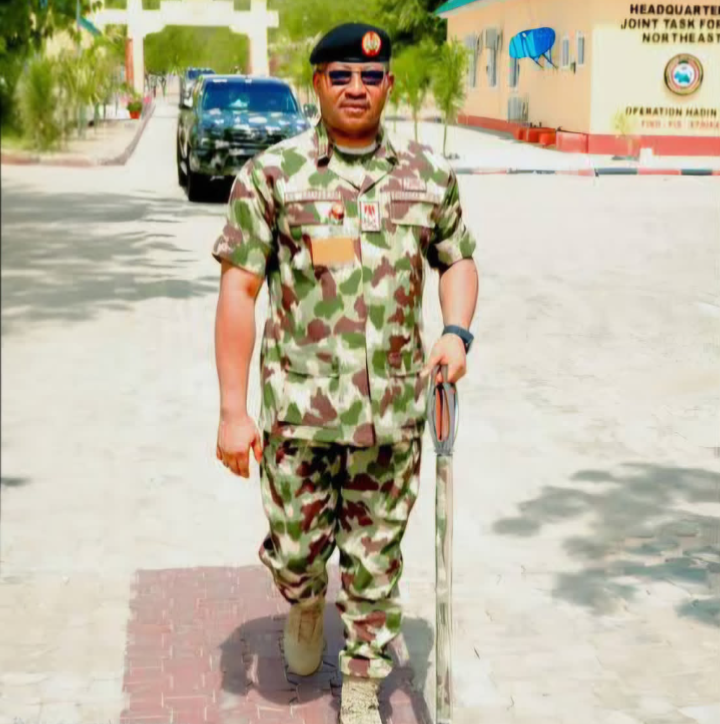
By Isiaka Mustapha, Editor-in-Chief, People’s Security Monitor
The outgoing Theatre Commander of Joint Task Force North East, Operation Hadin Kai, Major General Abubakar Abdulsalam, has left office with a formidable record of operational achievements, following a sustained campaign that significantly degraded the capabilities of Boko Haram and Islamic State West Africa Province (ISWAP) terrorists across the North East.
Presenting his farewell operational briefing in Maiduguri, Borno State, Major General Abdulsalam disclosed that troops under his command neutralised more than 1,200 terrorists, including 216 high value commanders, while also arresting 758 logistics collaborators who provided critical support to insurgent networks.
The outgoing commander stated that military operations conducted during his tenure, which began in April 2025, focused not only on direct combat engagements but also on dismantling the financial, logistical and operational structures sustaining insurgent activities in the region.
According to him, troops intercepted more than ₦350 million allegedly linked to terrorist financiers, dealing a major blow to the funding channels that support the operations of Boko Haram and ISWAP. He noted that disrupting the financial lifelines of terrorist groups remained a key component of the military’s overall counter insurgency strategy.
Abdulsalam further revealed that more than 500 assorted weapons and over 25,000 rounds of ammunition were recovered during various operations across the theatre. In addition, troops successfully located and destroyed more than 300 improvised explosive devices, significantly reducing threats to civilians, military formations and critical supply routes.
One of the most notable achievements recorded under his leadership was the systematic targeting of terrorist leadership. The elimination of 216 high value commanders weakened the command and control structures of insurgent groups and reduced their ability to coordinate large scale attacks against military and civilian targets.
The Theatre Commander explained that the arrest of 758 logistics collaborators reflected the military’s determination to dismantle the wider support networks responsible for supplying food, weapons, fuel, funds and intelligence to terrorist elements operating within the region.
Beyond battlefield successes, Abdulsalam said the command recorded a significant increase in the number of insurgents who voluntarily surrendered. He attributed the development to a combination of sustained military offensives and non kinetic measures designed to encourage terrorists to abandon violence and embrace rehabilitation opportunities.
The impact of military operations was also reflected in the gradual restoration of normalcy across several communities previously affected by insurgency. According to the outgoing commander, more than 7,000 displaced families were able to return to their ancestral homes, while over 3,000 Nigerians were repatriated from neighbouring Cameroon.
He added that improved security conditions facilitated the reopening of schools, markets and major transportation routes in several parts of the North East, creating opportunities for economic and social activities to resume after years of disruption caused by insurgent violence.
Abdulsalam expressed gratitude to President Bola Ahmed Tinubu, the military high command and the Borno State Government for their support throughout his tenure. He acknowledged that the provision of additional troops, combat equipment and other operational enablers contributed significantly to the successes recorded in the theatre.
His redeployment follows a recent Nigerian Army reshuffle approved by the Chief of Army Staff, Lieutenant General Waidi Shaibu. He has now been succeeded by Major General Ibrahim Ayodele Ajose, who is expected to consolidate the gains already achieved and sustain pressure on the remaining terrorist elements operating within the North East.
Security analysts view the achievements recorded under Abdulsalam’s leadership as a significant milestone in Nigeria’s ongoing counter terrorism campaign. The neutralisation of more than 1,200 insurgents, elimination of 216 key terrorist commanders, arrest of 758 collaborators, interception of over ₦350 million in suspected terrorist funds, recovery of hundreds of weapons and destruction of over 300 improvised explosive devices collectively underscore the intensity of military operations during the period.
Perhaps the most enduring legacy of his tenure lies not only in the battlefield statistics but in the gradual return of displaced families to their communities, the reopening of public institutions and markets, and the restoration of hope to thousands of citizens whose lives were disrupted by years of insurgency. These developments reflect the broader objective of Operation Hadin Kai: creating a secure environment where communities can rebuild, prosper and live free from the threat of terrorism.