 Keji Mustapha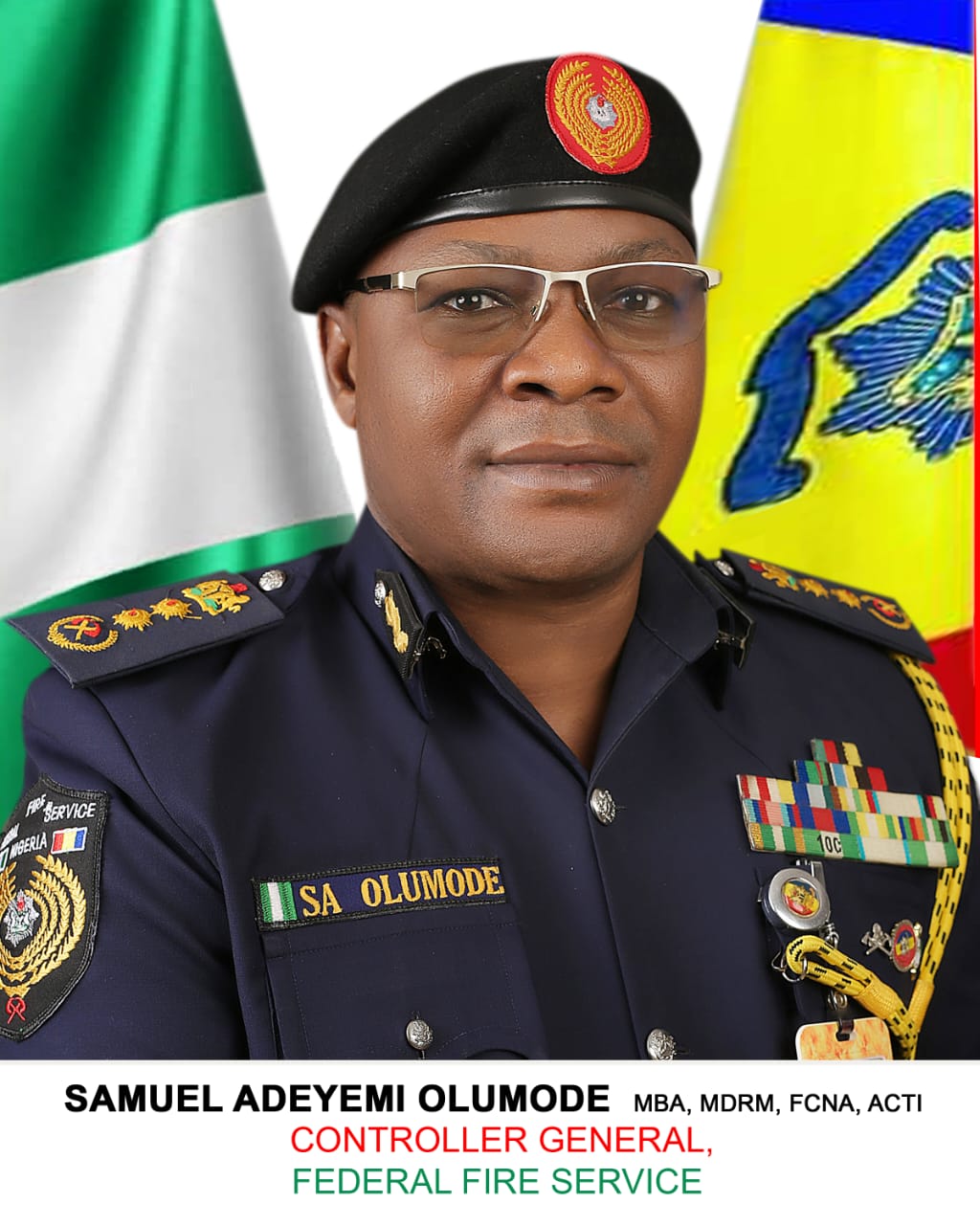
The Controller General of the Federal Fire Service (FFS), CGF Samuel Adeyemi Olumode, has stressed the urgent need for sustained capacity building and advanced training of fire service operatives as a key requirement for improving emergency response and public safety in Nigeria. He made this call while delivering a keynote address at the 2025 People’s Security Monitor Security Summit and Recognition Awards, where stakeholders gathered to discuss national security and institutional development.
Speaking on the theme “Institutional Renewal for Fire Service: A Blueprint for Effective Response,” the Controller General Olumode noted that as societies evolve, emergency response institutions must also adapt. He described fire and rescue services as critical pillars of national resilience, adding that effective firefighting depends largely on the skills, knowledge and preparedness of personnel.
He observed that fire disasters remain one of the most underestimated threats to lives and economic stability in the country. According to him, the ability of the nation to prevent, respond to and mitigate fire incidents is a true test of its preparedness. He explained that institutional renewal involves deliberate reforms in operations, technology, structures and organisational culture to reposition the Fire Service to meet global standards.
The Controller General said capacity building stands at the centre of this renewal drive. He disclosed that the Service is expanding specialised training programmes in firefighting, urban search and rescue, and fire investigation, in line with international best practices. As part of this effort, the Nigeria Fire Academy is being revitalised to serve as a regional centre of excellence for fire and rescue training in West Africa.
He also highlighted ongoing efforts to modernise firefighting equipment, noting that effective training must be supported with modern tools. These include advanced fire appliances, drones, thermal imagers, fire-retardant gear and specialised rescue equipment, all aimed at improving operational readiness across commands nationwide.
Beyond training and equipment, the Controller General said the Service is restructuring its operational systems by strengthening zonal and state commands, improving reporting mechanisms and establishing rapid response units. He added that data-driven decision-making, through improved fire statistics and risk analysis, will enhance prevention strategies and reduce avoidable losses.
He reaffirmed the commitment of the Federal Fire Service to building a modern, proactive and well-trained workforce, aligned with the Renewed Hope Agenda of President Bola Ahmed Tinubu. He called for stronger inter-agency collaboration, private sector support and community engagement, stressing that fire safety is a collective responsibility that begins with well-trained and motivated fire service operatives.