 Keji Mustapha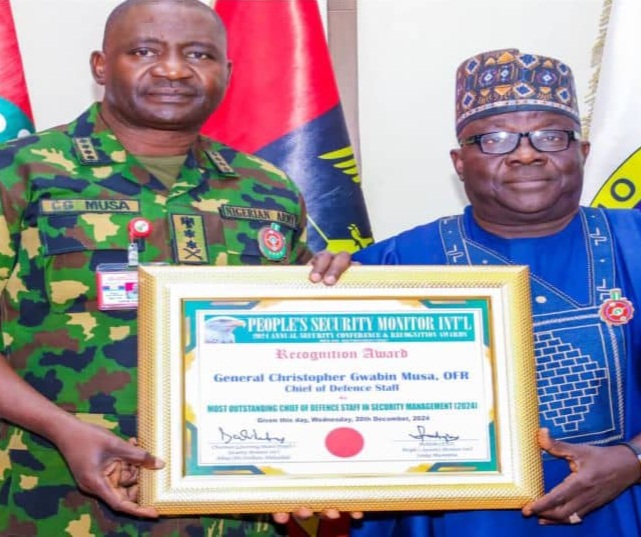
Pix: Isiaka Mustapha, CEO/Editor-In-Chief, People’s Security Monitor presenting the prestigious honour to General Christopher Musa
At a distinguished award ceremony held at the Defence Headquarters in Abuja, General Christopher Gwabin Musa, Nigeria’s Chief of Defence Staff (CDS), was honoured by the People’s Security Monitor for his outstanding leadership and commitment to national security. The award was presented by the organisation’s Chief Executive Officer and Editor-in-Chief, Isiaka Mustapha, in recognition of General Musa’s quality service delivery, especially in the fight against terrorism and his transformative reforms within the Armed Forces.
General Musa was applauded for his welfare-driven leadership approach, which has significantly improved morale and operational effectiveness within the military. Under his tenure, the timely disbursement of allowances, improved healthcare access, better living conditions in military barracks, and upgraded recreational facilities have been introduced to support the well-being of military personnel. These efforts, according to security analysts, are directly linked to increased operational success across various conflict zones in Nigeria.
In 2024 alone, the Nigerian Armed Forces recorded the neutralisation of over 8,034 terrorists, the arrest of 11,623 suspects linked to insurgent activities, and the rescue of 6,376 hostages from terrorist enclaves. These achievements have been widely credited to General Musa’s strategic vision and coordinated security operations across the country. Under his leadership, Nigeria also attained 99% of its OPEC production quota of 1.5 million barrels per day—a milestone linked to improved security in oil-producing regions.
Unofficial yet widely circulated figures suggest that the military may have neutralised as many as 10,937 terrorists, arrested 12,538 suspects, and rescued over 7,000 hostages, while seizing large caches of arms, ammunition, and illegally refined petroleum products. Though not independently verified, these statistics underscore the scale and intensity of the counter-terrorism drive under General Musa’s command.
Beyond combat operations, General Musa has invested in civil-military cooperation initiatives aimed at fostering peace and rebuilding trust in conflict-affected communities. Under his guidance, the military has built 50 schools and 30 healthcare centres, drilled boreholes, constructed local markets, and facilitated vocational training for over 5,000 youths across the North-East, North-West, and Middle Belt regions. These non-kinetic efforts are part of a broader peace-building strategy to win hearts and minds, address root causes of insecurity, and reduce recruitment by insurgent groups.
General Musa has also taken bold steps to institutionalise accountability and professionalism within the military. A new Military Ombudsman office has been established to address personnel misconduct, while a zero-tolerance approach to corruption has led to the prosecution of at least 15 senior officers in 2024 alone. Mandatory human rights training and strategic communication programs have been embedded into military operations to ensure ethical conduct in the field.
As Nigeria faces growing threats from jihadist groups infiltrating through its porous northern borders, General Musa has advocated for stronger border control measures, including the controversial proposal to fence sections of the Nigeria–Niger border. While the suggestion has drawn criticism from some quarters, it reflects the urgency of stemming cross-border insurgent movement and arms trafficking. He has also confirmed ongoing efforts with intelligence and financial crime agencies to identify and prosecute terrorism financiers, noting that arrests and legal proceedings have already begun, particularly in high-profile cases such as the Owo church bombing.
Speaking from Maiduguri in June 2025, General Musa reassured Nigerians that the situation was improving, urging citizens especially youth and academic institutions to partner with the military in consolidating peace. His consistent message to the public has been clear: national security is a shared responsibility. He has called on Nigerians to report threats, suspicious activities, and even misconduct by security personnel, emphasising transparency and collaboration.
The People’s Security Monitor award adds to the growing list of commendations General Musa has received from civil society organisations, religious groups, youth associations, and security analysts who praise his balanced approach to combating insecurity combining force with diplomacy, intelligence coordination, community development, and professional ethics.
With Nigeria’s security architecture undergoing critical reforms under his stewardship, General Musa continues to reinforce the Armed Forces as a disciplined, people-oriented institution, prepared not only to confront threats but to earn the trust of the very citizens it protects.