 Keji Mustapha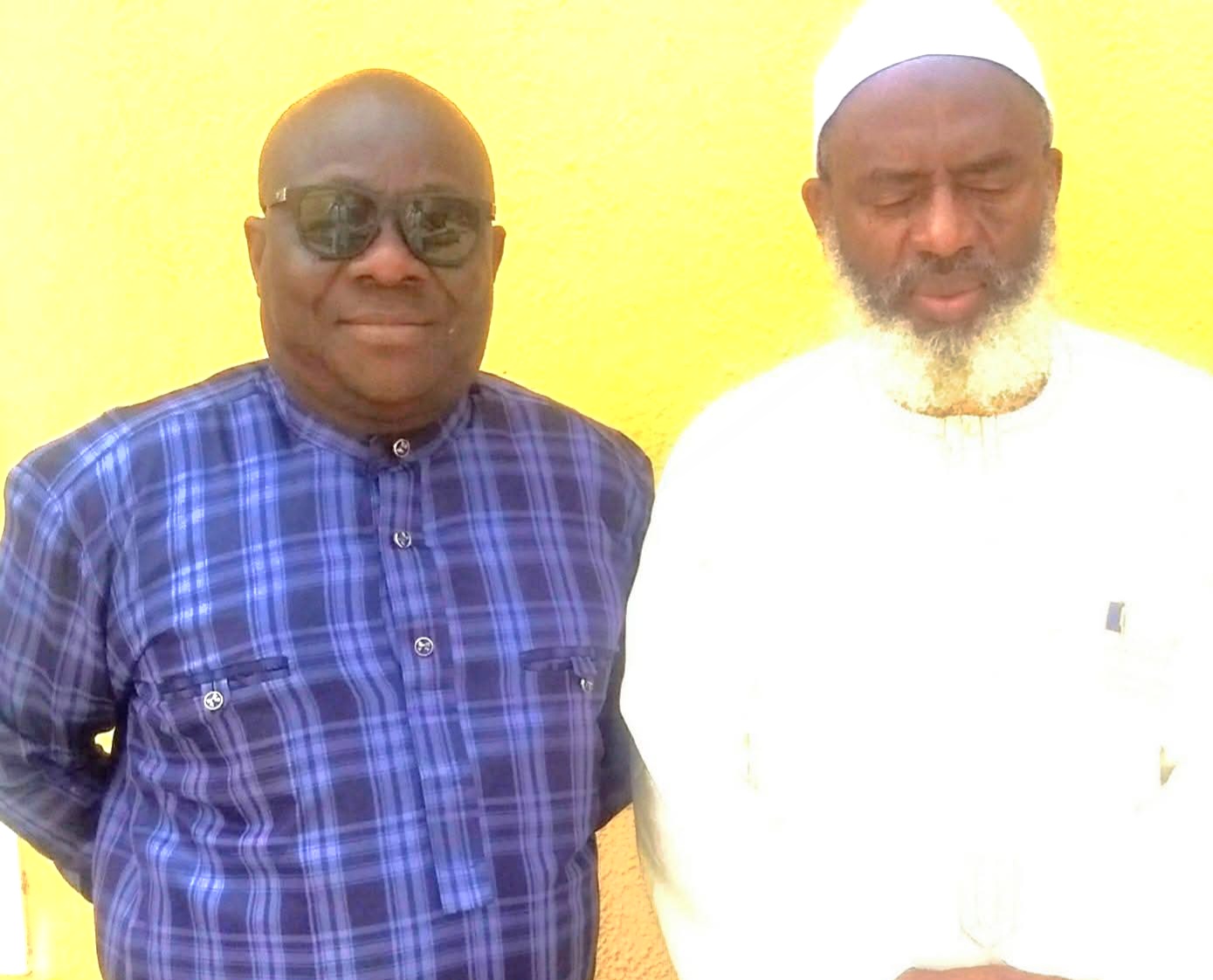
 |
Pix: L-R Isiaka Mustapha and Sheikh Gumi shortly after the interview
By Isiaka Mustapha, Chief Opoerating Officer/Editor-in-Chief, People’s Security Monitor
Securing an interview with Sheikh Ahmad Abubakar Gumi is no routine journalistic undertaking. For many Nigerians, gaining access to one of the country’s most influential and controversial Islamic clerics can be as daunting as navigating the layered complexities of Nigeria’s security architecture. His public profile, his outspokenness on national issues and his extensive following have combined to create an aura of mystery around the man whose pronouncements frequently shape public discourse.
My journey to his Kaduna base revealed a reality that sharply contrasts with many popular perceptions. Nestled within a quiet section of Kaduna metropolis, the expansive compound of the Islamic scholar operates under a carefully coordinated security arrangement. Visitors are screened, movements are monitored and access is regulated. The security network surrounding the cleric reflects the sensitivity of his position and the influence he commands among thousands of followers across Northern Nigeria and beyond.
Yet, beyond the security layers and public controversies stands a remarkably simple man. The image encountered during my exclusive visit bears little resemblance to the combative figure often portrayed in national conversations. Sheikh Gumi appeared relaxed, approachable and unpretentious, dressed in a simple jalabiya and modest sandals. There was no visible display of affluence, no lavish symbols of power and no attempt to project grandeur.
The modesty extends to his personal surroundings. His reception area is functional rather than extravagant, reflecting a lifestyle rooted in religious discipline rather than material indulgence. For a man whose views often dominate headlines and whose name regularly features in discussions on national security, the simplicity of his living environment comes as a surprise.
Born on October 1, 1960, Sheikh Ahmad Gumi is the eldest son of the late Sheikh Abubakar Mahmud Gumi, one of the most revered Islamic scholars in Nigeria’s history. The elder Gumi served as Grand Khadi of the former Northern Region and became a towering figure in Islamic scholarship. It was within this intellectual and religious environment that Ahmad Gumi’s worldview was formed.
His educational journey began at Sardauna Memorial College in Kaduna before he gained admission into Ahmadu Bello University, Zaria, where he studied Medicine and Surgery. The choice of medicine demonstrated an early commitment to public service, while the academic rigour of the university prepared him for future leadership roles.
Upon graduation, he joined the Nigerian Army Medical Corps as a medical officer. Military service exposed him to discipline, strategy and leadership under pressure. Rising to the rank of Captain, he served honourably before taking a decision that would redefine his future. Rather than pursue a long military career, he chose to retire from service and dedicate himself to religious scholarship.
His quest for deeper Islamic knowledge took him to Saudi Arabia, where he attended Umm al-Qura University in Makkah. There, he immersed himself in advanced studies of Islamic jurisprudence, Qur’anic interpretation and theology. The experience transformed him from a military doctor into a scholar whose influence would eventually transcend national boundaries.
Today, Sheikh Gumi is widely regarded as one of the foremost Islamic scholars in Northern Nigeria. Much of this influence is linked to the religious heritage he inherited from his father. Through his teachings and leadership, he has sustained a tradition of Islamic scholarship that continues to attract followers from different walks of life, including professionals, students, traditional rulers and community leaders.
Family life within the compound reflects a strict adherence to Islamic values. While the exact number of his children is not publicly known, it is evident that he presides over a large household. His wives and daughters are consistently seen observing conservative Islamic dress codes, while his sons embody the same religious discipline that defines the family’s lifestyle. Privacy remains a hallmark of the household, with family affairs carefully shielded from public attention.
Perhaps the most revealing aspect of our visit was Sheikh Gumi’s deep commitment to education. Away from the cameras and political debates lies a man convinced that education remains the most effective instrument for social transformation. Adjacent to his residence stands a substantial educational complex comprising nursery, primary and secondary schools established to nurture future generations.
The educational institutions are more than physical structures; they embody his philosophy that modern education and religious instruction must work together in building responsible citizens. Through these schools and other educational initiatives, he seeks to address ignorance, poverty and social dislocation, challenges he believes contribute significantly to insecurity and underdevelopment.
His passion for education extends beyond conventional classrooms. Over the years, he has advocated educational opportunities for underserved communities, including pastoral populations. His interventions in this area have earned him recognition among supporters who view education as the cornerstone of national progress.
What emerges from a close encounter with Sheikh Ahmad Gumi is a portrait far more complex than the public image often suggests. He is at once a trained medical doctor, a retired Army captain, an Islamic scholar, an education advocate, a family patriarch and a public commentator. These identities intersect to create one of the most intriguing personalities in contemporary Nigeria.
Beyond the headlines, controversies and public debates, Sheikh Gumi remains a product of scholarship, discipline and conviction. Whether admired or criticised, his influence on religious thought, education and public discourse is undeniable. My exclusive visit offered a rare glimpse into the private world of a man who continues to shape conversations on faith, society and national development from his Kaduna base, leaving an imprint that extends far beyond the walls of his modest home.
During the interview, Sheikh Ahmad Gumi offered a candid reflection on
the roots of religious extremism, his controversial engagement with
Fulani communities, and his unlikely journey into military service.
Drawing from his faith, the Islamic scholar said his understanding of
contemporary extremism is shaped by the teachings and prophecies of
the Holy Prophet Muhammad (SAW).
“As a Muslim, I believe in what the Holy Prophet foretold concerning
the end times,” he said. “The Prophet warned that a period would come
when religious exremism would be rampant in killing one another despite their
remarkable recitation and knowledge of the Holy Qur’an. He told his
followers that they would be astonished by the conduct of certain
individuals who would emerge claiming religious legitimacy while
embracing violence and bloodshed.”
According to him, the world has witnessed the manifestation of this
prophecy in different regions.
“We have seen it in Iran, Syria and Afghanistan. We have seen young
people taking up arms and engaging in violence without the guidance of
recognised scholars or established religious institutions. Many act
independently in pursuit of causes they believe in, and this is what I
describe as religious extremism.”
The cleric also addressed public criticism surrounding his frequent
visits to Fulani settlements, insisting that many Nigerians have
misunderstood the purpose of those engagements.
“Many people do not understand why I go to Fulani enclaves and hold
discussions with them. My primary objective is to prevent them from
being drawn into fanaticism and extremism. If such tendencies are
allowed to flourish, they will only compound the security challenges
we are already facing as a country.”
He explained that his interactions with the communities have exposed
him to deep-seated grievances that often fuel cycles of violence and
retaliation.
“Many of these communities believe that when their settlements are
attacked, their children killed and their livestock destroyed, they
are left completely helpless. They often do not know how to seek
justice through the legal system. They do not know how to initiate
litigation or pursue redress in the courts. In their minds, revenge
becomes the only available option.”
Gumi revealed that traditional mechanisms are sometimes employed to
mobilise community members for reprisals.
“In some cases, when a smaller settlement is attacked, kola nuts are
distributed among members as a signal for mobilisation. Once that
happens, retaliation follows, and the cycle of violence continues.”
He stressed that understanding the psychology, culture and worldview
of affected communities is crucial to finding lasting solutions.
“It is important to understand their beliefs, their fears and the
environment in which they live. Without that understanding, it becomes
difficult to address the root causes of the problem.”
The scholar noted that he rarely undertakes such visits alone.
“Most times, I go with government officials and other stakeholders. We
sit with them, listen to their concerns and try to identify practical
solutions to their problems. My experience over the years has
convinced me that there is still a great deal of work to be done.”
While acknowledging the role of community engagement, he maintained
that the ultimate responsibility lies with government.
“Only government possesses the resources and authority required to
address these issues comprehensively. The earlier we understand that
as a people, the better for our collective future.”
Reflecting on his military career, Gumi remarked that the story of how
he joined the Nigerian Army is perhaps more remarkable than the story
of how he left.
“I think how I got into the army is actually more interesting than how
I got out of it,” he said with a smile.
He recalled a period when military service was viewed with suspicion
in some communities.
“In those days, there was widespread apathy towards joining the
military. Many people believed the army was meant for rascals and even
considered it incompatible with Islamic values. However, that
perception was completely misplaced.”
According to him, his father strongly opposed such views and actively
campaigned for greater participation of northern youths in national
institutions.
“My father was a firm believer in integration. He believed young
people should be encouraged to participate in every sphere of national
life because that was the path to social and economic development. He
consistently advocated that position.”
His father’s stance, however, attracted criticism from those who
doubted his sincerity.
“Some people argued that he was merely talking and not willing to make
personal sacrifices. They challenged him to demonstrate his commitment
by allowing one of his own sons to join the military.”
The challenge eventually led to a conversation between father and son.
“He spoke to me about it, and we both agreed. At the time, I was
already a qualified medical doctor. I subsequently joined the Nigerian
Army Medical Corps.”
Gumi served in the military and eventually rose to the rank of Captain.
“My service took place during the administration of General Ibrahim
Babangida as Head of State and General Sani Abacha as Chief of Army
Staff. At the time, military officers who wished to pursue political
careers were allowed to resign their commissions and move into
politics.”
Having spent several years in service, he eventually decided it was
time to move on.
“I felt I had served enough and decided to leave, even though I was
originally expected to serve for about fifteen years.”
Looking back on his life’s journey, the Islamic scholar expressed
gratitude and contentment.
“I thank Almighty Allah for His blessings. I am satisfied and content
with what He has given me. My children are doing well. I have
twenty-four children, although sadly one of them has passed away.
Overall, I remain grateful for the life Allah has granted me.”
Throughout the discussion, Gumi repeatedly returned to a central
theme: that dialogue, understanding and effective government
intervention remain essential to preventing vulnerable communities
from drifting into extremism and breaking the cycle of violence that
continues to threaten peace and stability.