 Isiaka Mustapha
Reports filed by Isiaka Mustapha, who was in Jos.
Jos, known for its cool weather, scenic highlands, and history of cultural coexistence, was plunged into mourning once more on Friday, July 25, 2025. On that day, 27 caskets were laid to rest in the red soil of Plateau State. The deceased primarily farmers and locals from the Bindi-Jebbu and Tahoss communities in Riyom Local Government Area had fallen victim to a brutal and coordinated assault that took place in the early hours of July 15. Survivors recounted the attack as ruthless and meticulously executed under the cover of night.
According to local authorities, the attackers believed to be armed bandits or suspected herders stormed the villages under the cover of darkness. They arrived on motorcycles, wielding firearms and machetes, setting homes ablaze and shooting indiscriminately. Entire households were wiped out before dawn. By the time the gunmen retreated, 27 lives had been brutally wasted, over 30 others injured some critically and dozens of families left homeless. The injured were taken to medical facilities across Jos, including Jos University Teaching Hospital (JUTH) and Plateau Specialist Hospital.
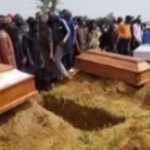
The burial ceremony was soaked in sorrow. Families wept over the caskets, many of which bore the remains of children, mothers, and elderly victims. Some collapsed in agony, needing to be carried away. Clerics delivered funeral rites with trembling voices while crowds of mourners stood in aching silence. Community leaders, political officials, and traditional rulers were present not only to offer condolences but to witness, once again, the scale of violence that continues to plague the region.
Chairman of Riyom Local Government, Bature Shuwa, described the tragedy as not just an attack on people, but on humanity itself. He commended Plateau State Governor Caleb Mutfwang for visiting the affected communities and offering immediate support, but he decried the continued failure of the security system to protect lives. “These people were asleep in their homes. They did nothing wrong. And now, we are burying them as though their lives were disposable,” he said. Many other leaders echoed their frustration, with some demanding that the federal government declare a security emergency in Plateau State.
Tragedy has become an all-too-common part of life for residents of Plateau State. In just the past seven months, the region has witnessed some of the deadliest attacks in recent Nigerian history. December 2023 saw coordinated assaults on 17 communities in Bokkos and Barkin Ladi Local Government Areas, leaving over 140 people dead. That Christmas Eve massacre shocked the nation and drew international condemnation. Yet, despite the widespread outrage, meaningful arrests or prosecutions failed to materialize.
Earlier, in May 2023, the town of Mangu experienced another horrific attack, with more than 100 people killed overnight. Eyewitness accounts painted a grimly familiar picture: attackers operating under cover of darkness, executing synchronized strikes, and security forces arriving far too late to make a difference.
The pattern continued in April 2022, when Kanam and Wase were ravaged by violence that claimed over 150 lives. Public protests erupted, and emergency motions were raised in the National Assembly. Still, the cycle of bloodshed remained unbroken, with little evidence of concrete action or sustained reform.
Behind the repetition of these massacres lies a deeper story one of systemic failure. Human rights groups, including Global Rights Nigeria and Amnesty International, have consistently pointed to the Nigerian government’s inability to prosecute perpetrators of rural violence. Ethnic tensions, land-use disputes, religious rivalries, and the proliferation of small arms have all been cited as contributing factors. But to the families now in mourning, these are abstractions. What they seek is safety, justice, and assurance that their children will not grow up under the shadow of nightly gunfire.
Governor Caleb Mutfwang, in a statement following the Riyom killings, condemned the attack as inhuman and intolerable. He pledged to strengthen collaboration with federal security agencies and called for increased deployment of personnel to the state’s rural areas.
Human rights lawyer Jummai Istifanus, speaking at the burial, described the recurring violence as the result of “criminal impunity.” “For every grave we dig, we bury a piece of our national conscience. If we do not act now, the very idea of Nigeria as a secure nation collapses,” she said. Her words were echoed by Senator Simon Mwadkwon, who represents Plateau North, in a speech at the National Assembly. He called for a rural security Marshall Plan and the establishment of special courts to expedite the trial of mass murderers.
The survivors of the Riyom attack have their own haunting testimonies. Rhoda Dachung, who lost her husband and two children, said she lay hidden beneath a bed while gunmen slaughtered her family. “They didn’t just shoot; they set fire to everything. I survived by God’s grace, but what do I have left?” Another victim, Yakubu Bitrus, recounted how the attackers operated freely for nearly two hours before any security response arrived. “We are surrounded by soldiers, but when it matters most, they are nowhere to be found,” he said.
Following the attacks, hundreds of villagers have fled their homes. Local officials report that over 1,000 internally displaced persons (IDPs) are now sheltering in temporary camps across Barkin Ladi and Jos South, with minimal access to food, water, and medical supplies. Aid agencies have been called in, but the scope of displacement continues to widen, threatening food security and economic stability in the region.
According to the Global Centre for the Responsibility to Protect, over 11,000 people have been killed in Nigeria’s North-Central zone due to rural banditry and communal violence since 2018. Plateau State alone accounts for over 1,200 of those deaths. Yet, convictions remain rare. In most cases, perpetrators vanish into the forests or blend into nearby settlements, rarely pursued or held to account.
This was not just the burial of 27 human beings; it was the burial of hope, of faith in the state’s ability to protect its people, of trust in a justice system that has failed repeatedly. The silence at the cemetery was pierced not just by cries, but by a national question: how many more?
The mass burial is a chilling reminder that peace in Nigeria is not a passive aspiration; it must be fought for, defended, and enforced through deliberate and courageous leadership. Until those responsible for these atrocities are apprehended and justice is served, the people of Plateau will continue to live in fear, and Nigeria’s red earth will remain soaked in innocent blood.





 Keji Mustapha