 Keji Mustapha
By Isiaka Mustapha, Editor-in-Chief, People’s Security Monitor
Leadership in a security organisation is not measured by how comfortable its decisions make everyone, but by the capacity to enforce standards, take difficult decisions and place institutional interest above personal convenience. In this regard, the leadership of the Nigeria Security and Civil Defence Corps (NSCDC), Oyo State Command, under Commandant Augustine Padonu, reflects a Commandant determined to strengthen discipline, order and professional administration. Since assuming responsibility for the command, Padonu has embarked on an administrative approach that seeks to review established practices, reposition personnel and create a structure more responsive to the operational demands of a modern security organisation.
One of the defining features of this approach has been the redeployment of personnel who had remained in particular positions for considerable periods. In a security institution, personnel rotation is an important management tool because it exposes officers to different responsibilities, broadens professional experience and allows Commanders to match personnel more effectively with operational requirements. It can also prevent overdependence on familiar routines and encourage fresh perspectives across departments and areas of responsibility. Padonu’s willingness to undertake such changes demonstrates that he is prepared to use the authority of his office to pursue what he considers necessary for the effectiveness of the Oyo Command.

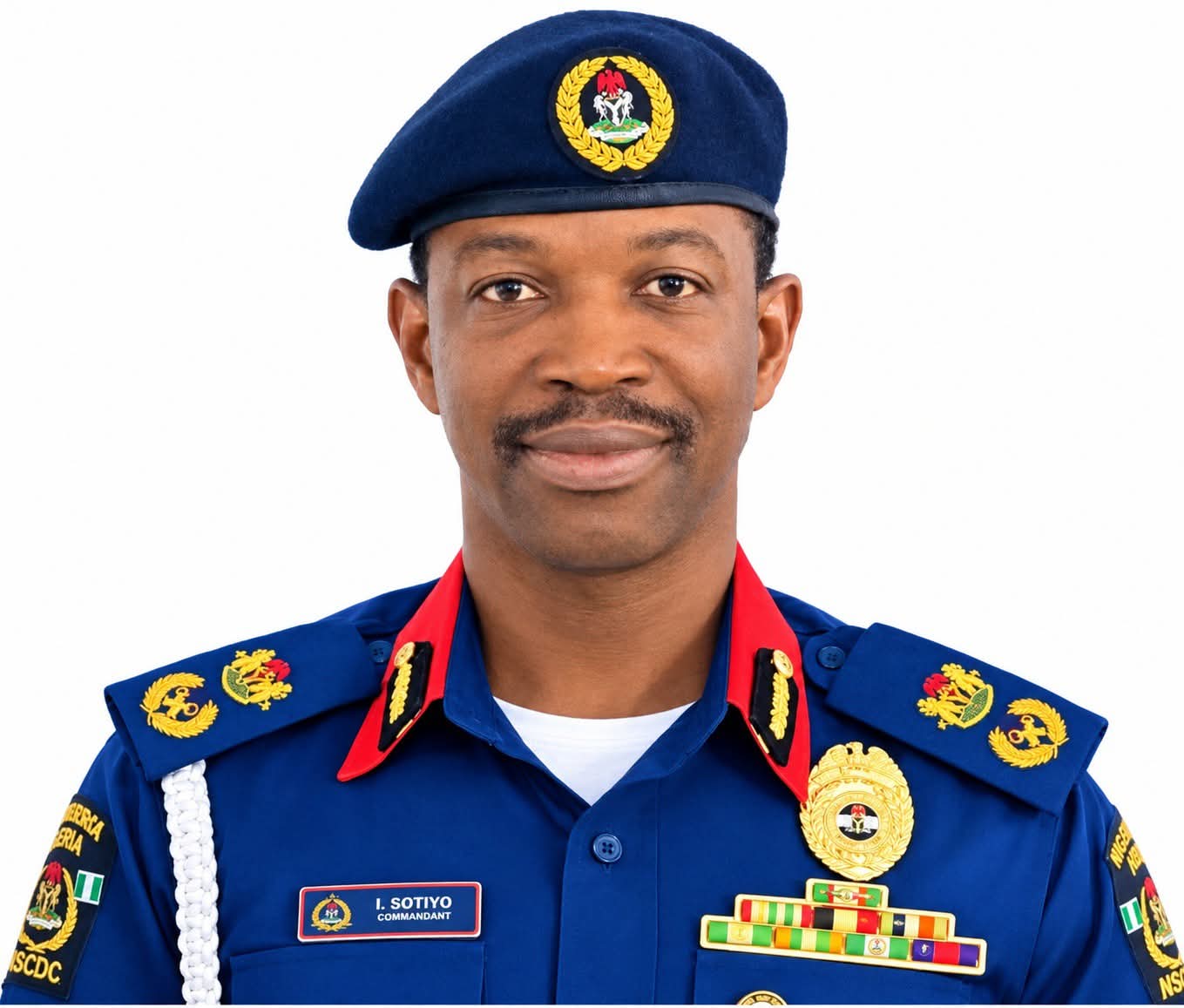
Commandant Padonu
The rationale for such administrative movement becomes clearer within the wider responsibilities of the NSCDC. Its personnel operate across communities, critical infrastructure, public institutions, commercial environments and other sensitive areas where professional judgement and institutional discipline are essential. Officers naturally establish relationships during prolonged assignments, but a disciplined security organisation must ensure that those relationships never overshadow official responsibilities. Periodic movement can therefore help preserve professional boundaries while strengthening supervision and institutional independence. Viewed from this perspective, Padonu’s restructuring of personnel represents more than a routine reshuffle; it reflects an attempt to maintain a command structure capable of adapting to changing operational requirements.
There is also a leadership quality in Padonu’s willingness to disturb established routines where he considers change necessary. Security command is not an office designed merely to preserve existing arrangements. It requires judgement, decisiveness and the ability to act when circumstances demand it. A commander who consistently avoids difficult choices may maintain temporary calm but leave administrative weaknesses untouched. Padonu has instead demonstrated a readiness to make decisions that affect the existing structure of his command, an approach that deserves recognition when viewed against the demanding responsibilities attached to his office.
The separate allegation concerning an alleged financial contribution for Padonu’s birthday requires a different consideration. The Commandant has categorically denied directing personnel to contribute money for his birthday, church activities or any other personal purpose. He has maintained that he neither requested nor authorised anyone to collect money from personnel on his behalf. His account places the issue squarely within the realm of facts that can be established through proper inquiry rather than assumptions drawn merely from the existence of an allegation.
If a collection took place, the material questions are who initiated it, under whose authority it was conducted, who received the money and whether Padonu knew of, authorised or benefited from it. Those facts are essential because the existence of an activity within a large command does not automatically establish personal involvement by the officer at its head. Any investigation should therefore establish the actual chain of events and distinguish clearly between actions personally authorised by the Commandant and those undertaken independently by subordinate personnel.
This is important not only for Padonu but for the credibility of the NSCDC’s administrative system. Legitimate complaints should be investigated, while officers should not be condemned merely because allegations have been made against them. If evidence establishes misconduct, the appropriate disciplinary machinery should take its course. If the evidence does not establish the allegation, the matter should not continue indefinitely as an assumed fact. Such an approach protects both accountability and the professional integrity of the institution.
The more substantial question surrounding Padonu’s leadership, however, is the direction in which he is taking the Oyo Command. His responsibilities extend beyond personnel postings to discipline, operational coordination, protection of critical assets and the maintenance of public confidence in the Corps. These duties require a Commandant capable of balancing firmness with fairness and authority with accountability. Padonu’s administrative posture indicates an effort to establish a command culture in which professional responsibility takes precedence over personal convenience.
For personnel affected by the changes, the appropriate institutional response is to use recognised channels where they believe a decision is improper. Security organisations necessarily make personnel decisions based on organisational requirements, and officers cannot expect every assignment to remain permanent. At the same time, administrative decisions must remain subject to the regulations governing the Corps. This balance allows commanders to manage their formations effectively while preserving legitimate avenues through which personnel can raise concerns.
The Oyo Command also has an opportunity to benefit from the institutional renewal associated with personnel movement. Officers exposed to new departments and responsibilities can acquire additional experience, while supervisors gain a broader understanding of the strengths and capabilities within their formations. Over time, such mobility can contribute to a more versatile workforce and reduce excessive dependence on individuals occupying particular assignments. For an organisation operating within Nigeria’s complex security environment, developing such institutional depth is important.
Padonu’s approach should therefore be understood within the broader evolution of professional security management. Modern security organisations require Commandants who can adapt personnel structures to operational realities rather than simply inherit arrangements unchanged. Administrative reform is most useful when it is accompanied by clear procedures, professional communication and measurable improvements in organisational performance. The challenge before the Oyo Command is to translate the changes into stronger discipline, improved efficiency and better service to the public.
The controversy surrounding the allegations should consequently not obscure the larger responsibilities of command. Padonu has denied the financial allegation, while his administrative decisions remain subject to the rules and oversight mechanisms of the Corps. Both matters can be addressed without conflating them. The appropriate institutional approach is to examine allegations on their facts and administrative decisions on their merits, without allowing either issue to prejudge the other.
Ultimately, the true measure of Padonu’s tenure will lie in the professionalism of the personnel under his command, the efficiency of the administrative structure, the effectiveness of operations and the confidence the Command earns from the communities it serves. His readiness to confront complacency and undertake personnel restructuring signals a clear commitment to institutional renewal. If sustained within the regulations of the Corps and guided by professional discipline, fairness and accountability, Padonu’s leadership could mark a significant phase in the drive to build a more efficient, responsive and professionally managed Oyo State Command.